
Know what every account needs next.
No CRM and no PSA is required. We read the exports, spreadsheets, documents and decks you already keep, capture what your people know in minutes of conversation, and bring in what is happening at your client from outside.
Ampsio shows account managers what each client account needs this week, and shows firm leaders where account performance is at risk, drawn from evidence rather than from status reports.
Accounts run this way build stronger client relationships, and stronger relationships show up in the three places a professional services firm actually grows.
Nothing in the firm holds the account
Something in every firm tracks opportunities and something tracks the work, whether that is a CRM and a delivery system or a spreadsheet, a folder of plans and the deck from the last review. Each of those does its own job properly. The account itself sits between them, which is where retention and growth are actually decided, and it lives in the memory of whoever happens to be running it.
- 01Billable work on the account, usually the hardest parts of it
- 02Selling the next piece, and defending the rate while they do it
- 03Holding the client relationship, including the people above the sponsor
- 04Managing and coaching the consultants on the account
- 05Watching delivery quality, and putting it right when it slips
- 06Hiring and onboarding, because they know the account better than anyone
Every one of those jobs has a vendor selling into it. The CRM serves the person selling. The delivery system serves the project. The HR platform serves the manager. Nothing was built for the person doing all six at once, which is why the account ends up held in one person’s head rather than in anything the firm owns.
What most firms run today
An account manager spends a large part of the week assembling a picture from whatever the firm happens to keep, then reports it upward. By the time a problem is visible in that report, the client has usually seen it first.
What Ampsio puts in place
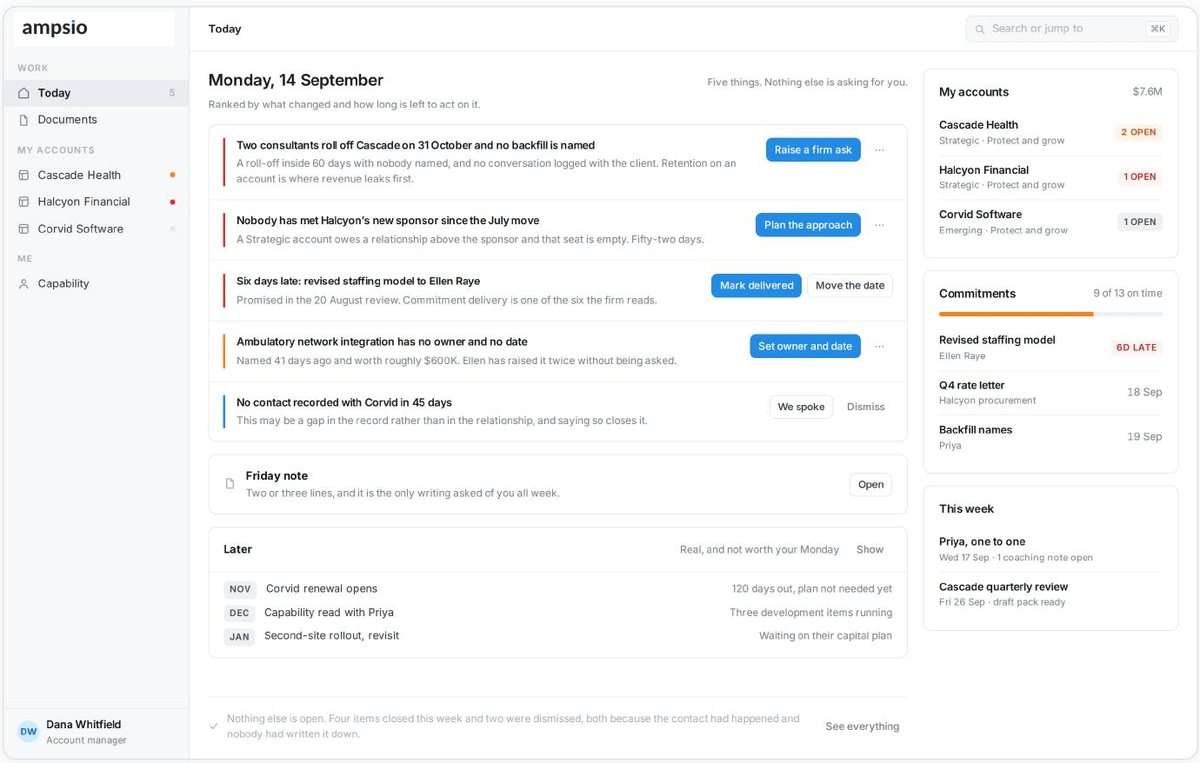
One account record that stays current, a ranked short list of what actually needs attention this week with the reason each item surfaced, and a history that survives a change of manager.
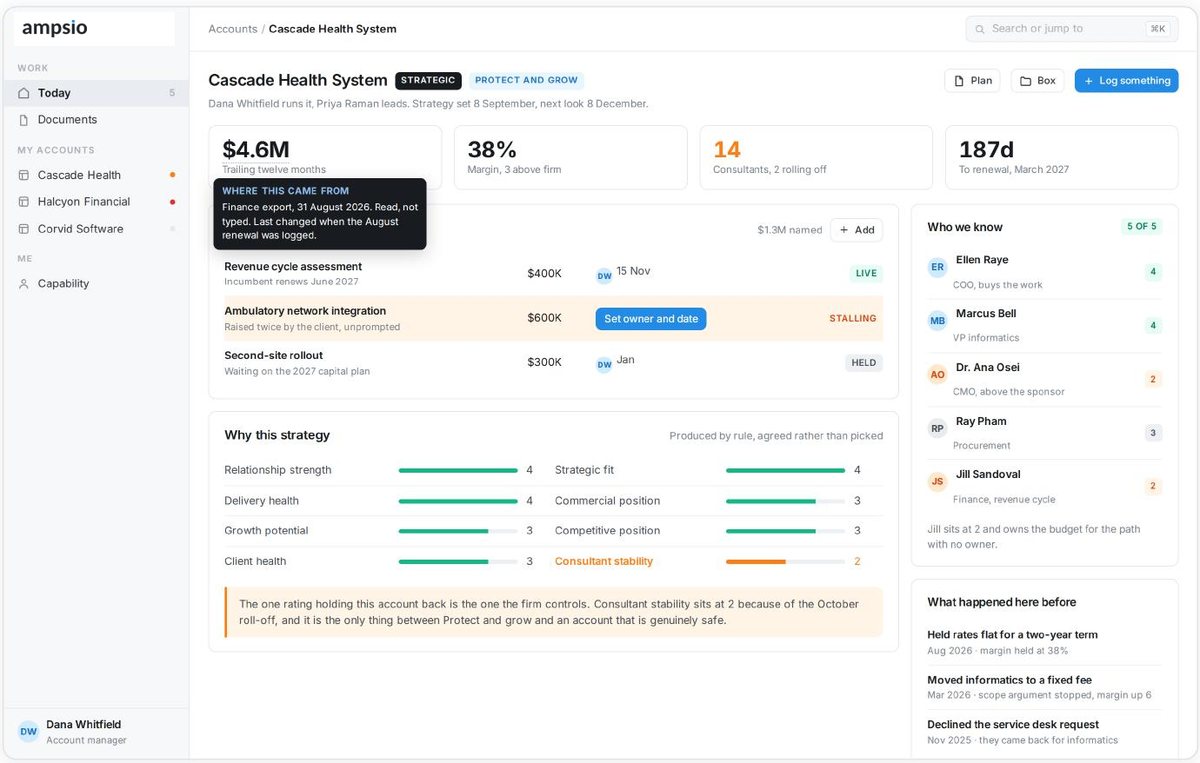
Five steps, run weekly, each one feeding the next
The loop is the product. Every step takes something in and hands something on, which is what keeps the account record current without anyone being asked to maintain it.
Gather
Resolve
Rank
Act
Capture
Maturity is read from the accounts rather than asked of the firm. A capability with no evidence behind it is left blank. A forecast means nothing until it has been graded against what actually happened.
How well an account is run is a capability question, and it can be read
Account outcomes are usually explained by the account. In our experience they are explained at least as often by what the person running it can demonstrably do. Ampsio reads twelve capabilities against evidence the account already produces, from client understanding and commercial management through to judgment and escalation, each on the four-point scale below.
What the rating is for
A rating with no evidence behind it is left blank rather than guessed, because a filled-in grid that nobody can point at is worse than an honest gap. The read points at what the firm puts behind a person, which is coverage and coaching, and never at a score that follows them around.
What it changes
A firm that can see capability against the accounts it is actually running can put its strongest people where the demand is, pair a developing manager with someone who has done it before, and build a development path from evidence the work already produces.
The account against the person running it
Reading capability on its own settles very little. What decides whether an account is safe is the capability of the person running it set against what that particular account actually demands. Plotting the two together is what turns a rating into a decision about coverage.
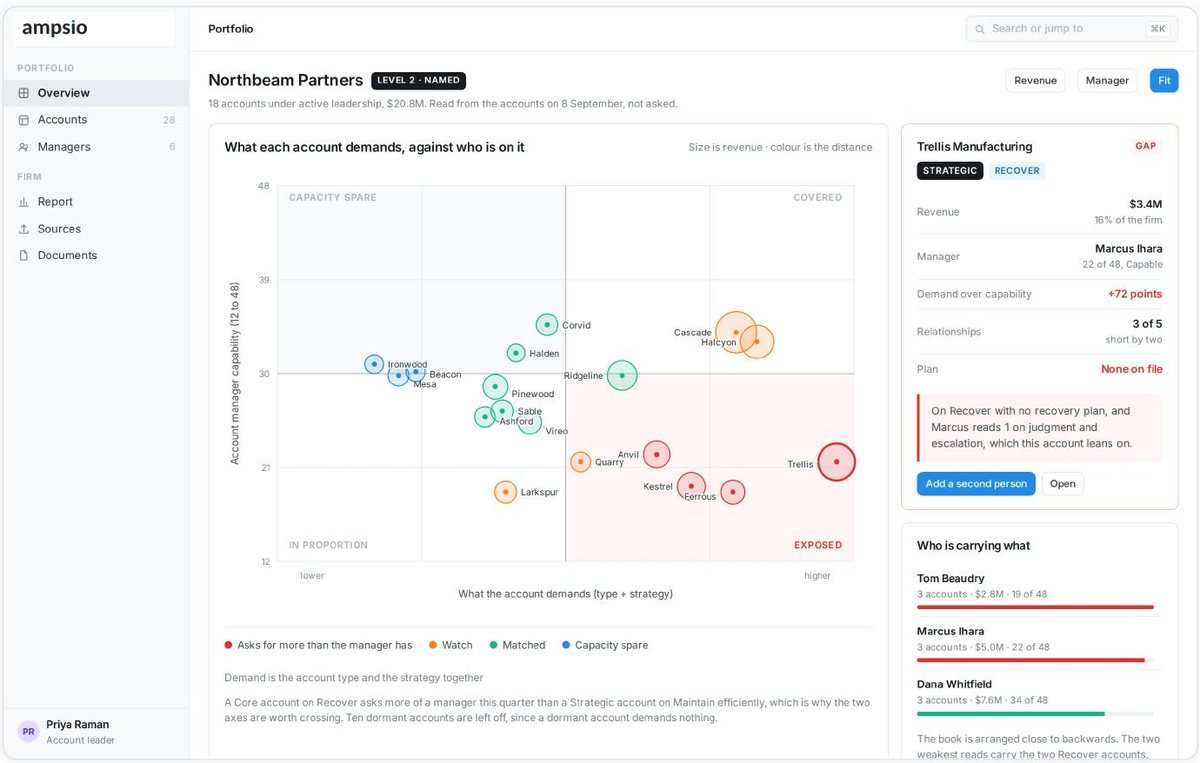
Capability sitting idle
A strong manager on an account that asks little of them. Usually the first place to look when a demanding account has nobody to give it.
Backed correctly
The account that most needs judgment has someone who can bring it. Worth watching for the day that manager moves on.
A safe place to develop
Where a developing manager should be learning. The account can absorb a mistake, and the coaching has somewhere to land.
Exposed
A developing manager alone on an account that demands more than they can yet give. The one square that overrides everything else, and usually found after the account is already slipping.
Five places the account record pays for itself
The account record resolves people, work, commercial history, commitments and risk into one structure. Five effects come out of that structure, and each one is measurable inside a firm using the firm’s own numbers.
Capacity returned
The hours that went into assembling a status picture go back to client work. Reported in hours rather than in headcount.
Consultants held
Roll-off and delivery-health signals surface weeks before the client feels the gap, so a seat can be refilled instead of lost.
Accounts retained
Renewal confidence falls into the view of someone with the authority to act on it, while there is still time to act.
Expansion converted
A growth path picks up an owner and a date at the moment it is named, rather than being mentioned and then forgotten.
Account memory kept
The account keeps its history through a change of manager, so a handover stops costing the relationship.
None of this creates demand. It stops capacity going where demand is not, returns the hours that go into rebuilding the account picture before every review, and makes a win repeatable rather than personal.
It starts with half a day and your own accounts
Nothing is installed to begin with. The first session runs on the accounts you already have, with the people who already run them, and it produces a read of where the firm actually stands rather than where it believes it stands.
- 01
Diagnose
A working session with the portfolio owner and each account owner. Six or more accounts, the people who run them, half a day. No workbook, no prior data, no preparation needed. Everything rests on evidence the accounts already produce, so the read holds up when you take it to your partners.
Half a day - 02
Tier
Which accounts earn which depth of attention, scored against a written method rather than settled by seniority in the room.
Same week - 03
Equip
The standard itself. What an account manager is accountable for, what a plan contains, how commitments get graded.
Weeks 2 to 4 - 04
Plan
Plans written against that standard, in one idiom rather than one per manager. Runs alongside Equip rather than after it.
Weeks 3 to 6 - 05
Run
The weekly loop in the software, with the record staying current as a by-product of the work.
Weekly, ongoing
What we need from you
A named executive sponsor, six to twelve accounts spanning the range you actually lead rather than only the biggest, and an hour or so a week from each participating manager.
What you walk away with
A read of where your accounts actually stand, a settled answer on which ones are at risk and why, and your firm placed on the maturity scale from evidence rather than opinion. Firms usually find the half day pays for itself in the argument it ends.
Firms whose growth depends on a handful of accounts
Consulting, staffing and professional services firms where account management already exists as a job but has no system behind it.
The account manager
Gets the week back, and walks into a client meeting current on the history, including the parts held by people who have since left.
The account leader
Sees the whole portfolio ranked, with reasons attached, and coaches from evidence instead of asking for a status email.
The executive
Finds out about an account in trouble while there is still time to act on it, rather than at the renewal conversation.
The person who feels the difference without ever touching the software
Your client is the one relationship in this that has no account and no login, and they are the one who notices first. What changes for them is the texture of working with your firm, and it shows up in the ordinary moments rather than in a review at the end of the year.
- They stop starting overThey stop re-explaining their own business every time someone rotates off, because the history sits with your firm rather than with a person who has moved on.
- Continuity through a changeA new manager arrives already current on what was decided, what was tried and what came of it, so the relationship keeps its footing.
- Notice rather than announcementThey hear about a staffing change or a delivery risk while there is still a conversation to have about it.
- A review worth their hourThe quarterly conversation is drawn from a record kept all along, so it is about what to do next rather than a recital of what already happened.
Built by, for, and with account managers.
If account management is already a job at your firm and nothing sits behind it, we would like to hear how you are running it today.
We are taking on three development partners in the fall of 2026. A development partner runs the system on their own accounts, shapes what gets built next, and keeps what we build together.